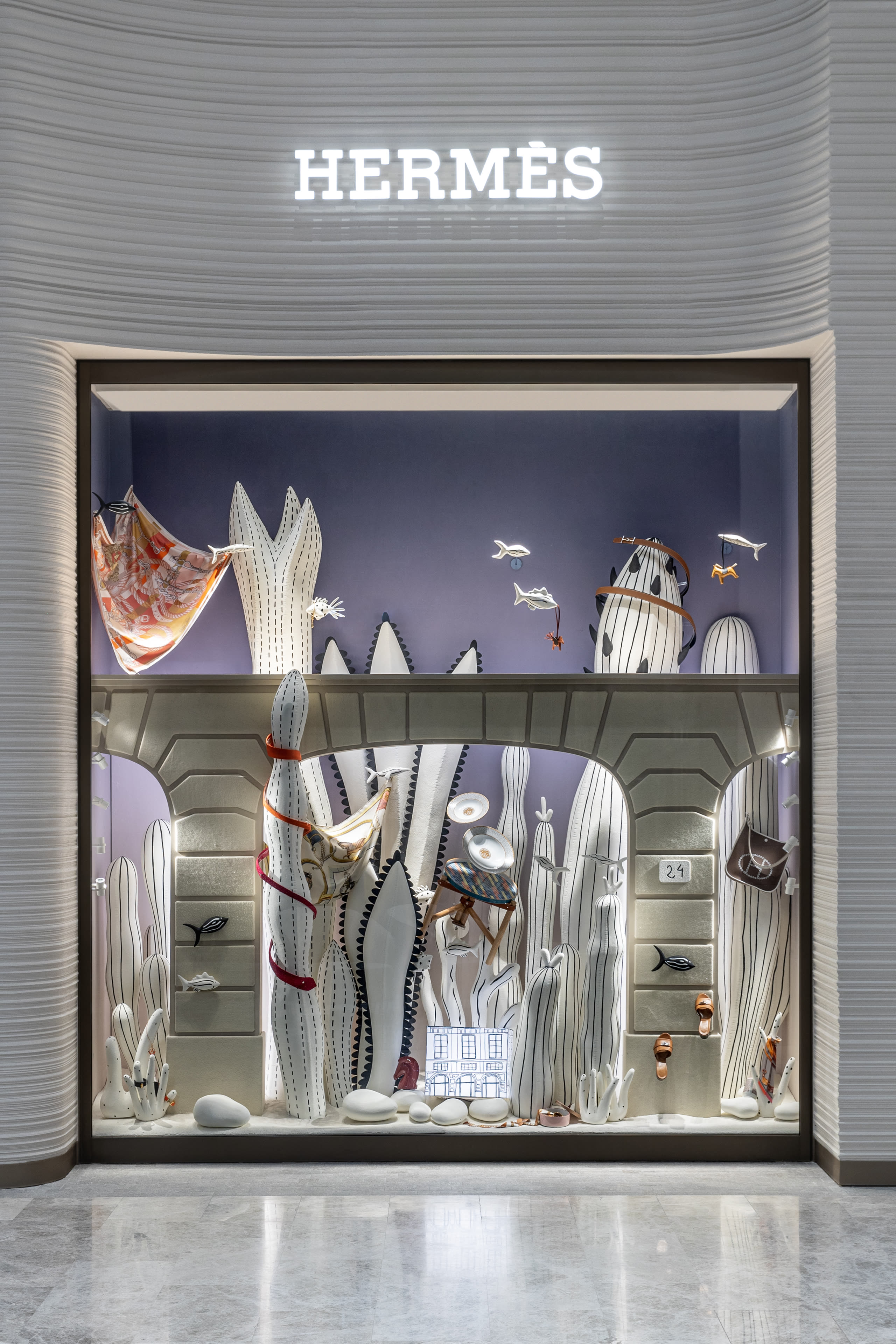
For two consecutive seasons, Dune Studios has designed windows for a French luxury maison's Middle East flagships — from Dubai Mall and Mall of the Emirates to Kuwait, Qatar, Bahrain and Abu Dhabi. Each window is a few square metres that must carry an entire maison, so we treat it as a small piece of theatre: conceived as a sketch, proven in photorealistic CGI, and only then built.
Our role covers the full arc — concept, art direction, 3D visualisation, technical plans and material specifications — delivered with our window display design practice for the maison's regional team.
Dubai is unforgiving to lazy window design: the malls are air-conditioned catwalks with the highest luxury footfall in the region, and a window competes with fifty others on the same corridor. That pressure is exactly why we prototype every sightline in 3D before a single panel is cut — in this market, "almost right" is invisible.
Sketch first, render second, build last
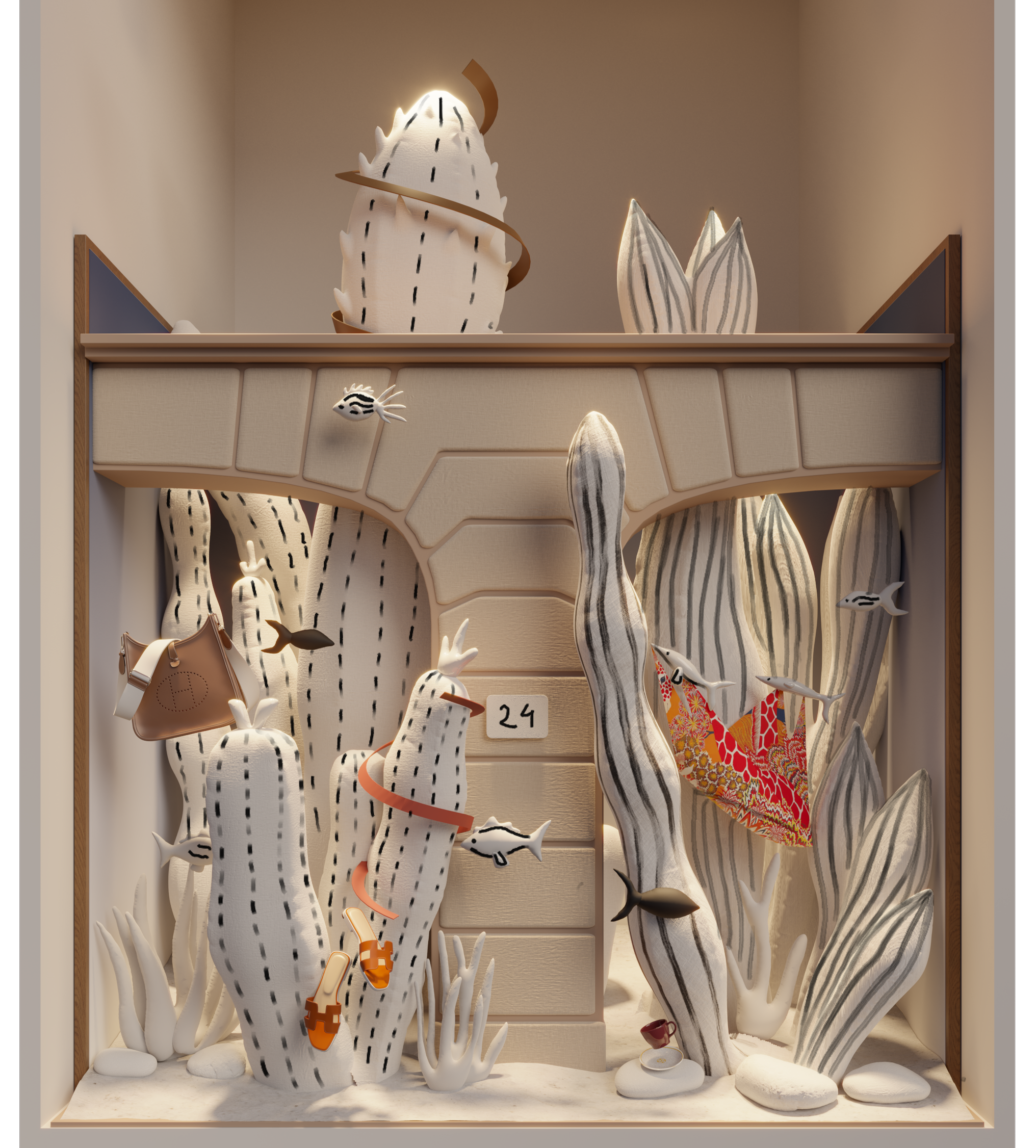
Every scheme begins on paper, with the maison's seasonal theme as the constraint. We then model each window in its actual storefront — glass lines, sightlines from the mall floor, lighting rigs — so the render a client approves is literally the photograph a shopper will take. Nothing is left to interpretation between the CGI and the carpenter.
That discipline is what lets a single concept survive translation across four countries and six very different storefronts without losing its nerve.
The Hidden Treasures scheme alone required four storefront-specific adaptations: different glass heights, different approach angles, different lighting conditions per mall. Each variant got its own CGI set, its own technical drawings and its own production notes — the concept stayed identical, the engineering did not.
Two schemes, six storefronts
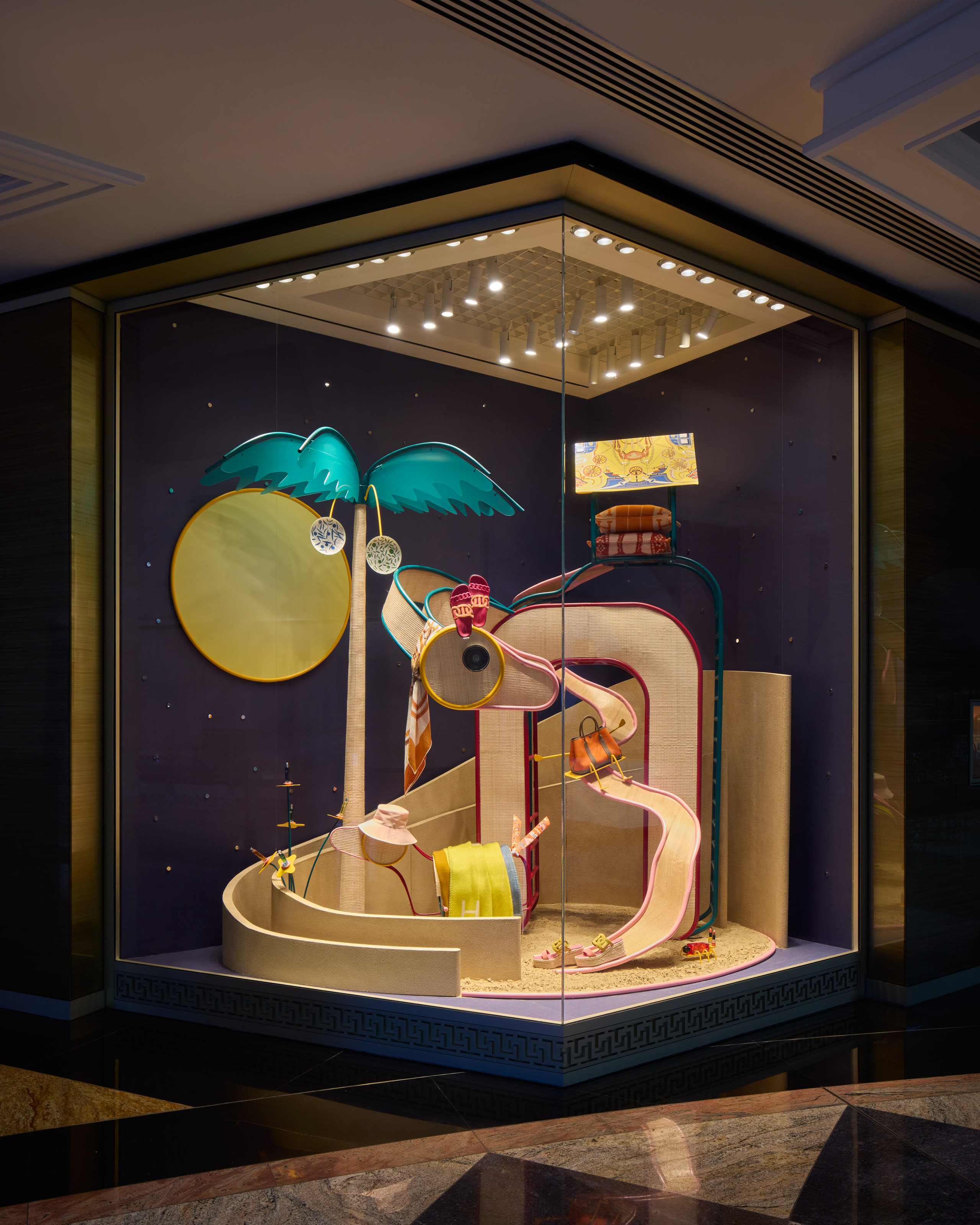
In December 2024, Hidden Treasures of the Faubourg turned the windows into a dreamlike underwater world — white sculptural corals and crepe-paper fish hiding treasures from 24 Faubourg — installed at Dubai Mall, The Galleria Abu Dhabi, Bahrain and Qatar. A year later, Utopic Playgrounds filled Mall of the Emirates and the Kuwait flagship with abstract Middle Eastern fauna rebuilt as slides and climbing frames, with bags, silks and fragrances joining the fun.
The same relationship extends beyond the glass: an eight-metre hoarding artwork at Dubai Mall and the projection-mapped Daydream Flight dinner show how one visual language can scale from a vitrine to a wall to a whole room.
Working with a maison of this calibre means working inside a century of visual codes. Our job is to extend that language — the horse, the chaîne d'ancre, the Faubourg address — into places it has not been before, without ever breaking it. That tension between heritage and play is where these windows live.